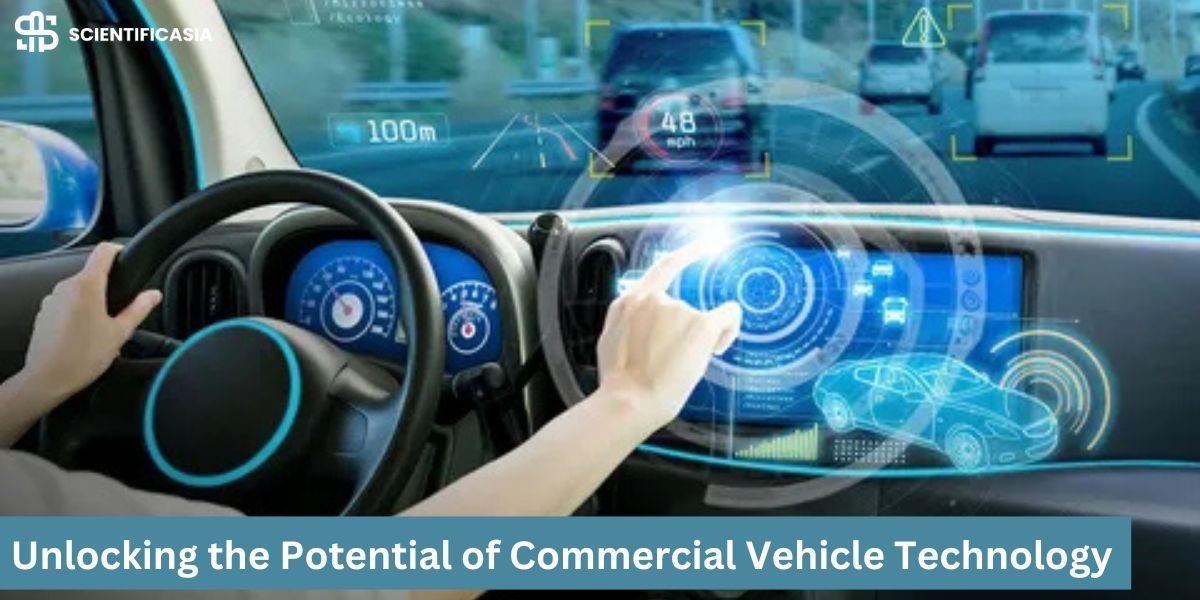
Commercial vehicle technology covers the design, engineering, and production of vehicles built for commercial use: the trucks, buses, and vans that move goods and people and keep the global economy running. It is one of the fastest-changing areas in transport right now, driven by electrification, automation, and increasingly strict safety regulations.
To put the scale in perspective: the global commercial vehicle market was worth roughly $1.23 trillion in 2025 and is projected to reach around $2.2 trillion by 2035 (Cervicorn Insights, 2026). This article covers what the technology entails, where the industry is headed, and 2026 data showing how quickly it is moving.
Types of Commercial Vehicles
Commercial vehicles come in many sizes and configurations:
- Trucks, from small pickups to large semi-trailers, used to move goods over land
- Buses, including city buses, school buses, and long-haul coaches
- Delivery vans, used for packages and last-mile logistics
- Specialized vehicles, such as waste management trucks, construction equipment, and emergency response units
Businesses across the food, beverage, electronics, automotive, and healthcare sectors rely on these vehicles to keep operations running.
Key Components
Several core systems work together in any commercial vehicle:
- Engine, supplies the power for motion
- Transmission, transfers power from the engine to the wheels
- Chassis, the frame supporting everything else
- Suspension, absorbs road shocks and vibrations
- Brakes, slow and stop the vehicle
- Steering system, lets the driver control direction
Engine and Fuel Technology
Internal Combustion Engines
Internal combustion engines have powered commercial vehicles for decades and continue to improve. Turbocharging and direct injection have raised fuel economy, while catalytic converters, selective catalytic reduction (SCR), and diesel particulate filters (DPFs) have cut harmful emissions significantly.
Alternative Fuel Technologies
The shift away from pure diesel is well underway:
- Hybrid electric vehicles (HEVs) combine a combustion engine with an electric motor for better fuel economy
- Plug-in hybrids (PHEVs) add a rechargeable battery for electric-only range
- Fuel cell electric vehicles (FCEVs) use hydrogen to generate electricity, emitting only water vapor
The Electrification Supercycle
Electrification is the defining change in commercial vehicles right now, and the numbers are striking. The electric commercial vehicle market was worth around $190 billion in 2026 and is projected to reach $575 billion by 2035, growing at about 13% a year. Global electric commercial vehicle registrations passed 5.8 million units in 2025 (Business Research Insights; Grand View Research, 2026).
Adoption is no longer marginal:
- Battery-electric trucks accounted for 41% of electric fleet additions in 2025
- Electric buses made up 39% of newly procured public transit buses worldwide
- More than 62% of urban delivery operators adopted at least one electric commercial vehicle
Lithium-Ion Batteries: Benefits and Challenges
Lithium-ion batteries, which transformed consumer electronics, are now central to commercial EVs. Their advantages are high energy density, long cycle life, and fast charging. The obstacles are real too: high upfront cost, limited range for long-haul use, and the need for charging infrastructure.
Progress on these is rapid. Battery-electric trucks capable of more than 700 km per charge appeared in 2025, and Volvo announced a 700 km heavy-duty model in May 2026. Solid-state battery pilots improved charging speed by 28% and cut battery weight by 19%, and battery-swapping systems can now replace a commercial vehicle’s pack in around 10 minutes (Business Research Insights, 2026).
Strategies accelerating adoption include government incentives and subsidies, battery recycling and reuse to lower costs and environmental impact, and continued R&D into performance and safety.
Transmission, Chassis, and Aerodynamics
Transmissions have advanced with automated manual transmissions (AMTs), continuously variable transmissions (CVTs), and dual-clutch transmissions (DCTs), each balancing efficiency and smoothness differently.
Chassis and suspension improvements focus on lightweight materials such as aluminum and carbon fiber to reduce weight and improve fuel economy, advanced air suspension and adaptive dampers for ride comfort, and aerodynamic design to cut drag.
Safety Technology and the Move to Mandated Systems
Technology has reshaped commercial vehicle safety, and much of it is no longer optional.
Advanced Driver Assistance Systems (ADAS)
ADAS improves road safety through features including:
- Lane departure warning, alerting the driver when the vehicle drifts
- Forward collision warning, monitoring the road ahead
- Automatic emergency braking (AEB), applying the brakes if the driver does not react in time
- Stability control, detecting and reducing rollover risk in large vehicles
- Adaptive headlights, adjusting intensity and direction to conditions
- Rear-view cameras and proximity sensors, reducing blind spots
Crucially, these are shifting from optional features to legal requirements. The EU General Safety Regulation has required systems such as automatic emergency braking and lane-keeping on new vehicles since 2024. In the US, the NHTSA finalized FMVSS No. 127 in April 2024, requiring automatic emergency braking with pedestrian detection on new light vehicles from September 2029. The ADAS market is expected to grow from 361 million units in 2026 to 583 million by 2033 (MarketsandMarkets, 2026).
Electronic Logging Devices and Telematics
Electronic logging devices (ELDs) enforce Hours of Service rules, capping working hours to prevent fatigue-related accidents. Telematics systems track a vehicle’s position, speed, and driving behavior, providing data that supports both fleet efficiency and accident investigation.
A Note on Safety Technology and Responsibility
These systems reduce human error, which is a leading cause of commercial vehicle accidents, but they assist attentive drivers rather than replacing them. Over-reliance and complacency are genuine risks, and system failures do occur. The practical view across the industry is a two-part approach: adopt the technology, and continue to emphasize driver training and awareness. Understanding which systems a vehicle carries also matters after an accident, since telematics and ELD data are increasingly central to establishing what happened.
Software, Connectivity, and Cybersecurity
Modern commercial vehicles are becoming software-defined platforms, which brings two important developments the industry is only now grappling with.
Over-the-air (OTA) updates let manufacturers improve vehicles remotely, adding features and fixing issues without a workshop visit.
Advanced cybersecurity systems have become a serious concern as a result. OTA update channels and vehicle-to-everything (V2X) communication modules create attack surfaces that could allow fleet-level disruption. In response, manufacturers are adopting the ISO/SAE 21434 automotive cybersecurity standard (Market Research Future, 2026).
Connected Vehicles
Connected vehicles share data with infrastructure:
- Vehicle-to-vehicle (V2V) communication shares speed, location, and braking status to improve safety and traffic flow
- Vehicle-to-infrastructure (V2I) communication exchanges data with traffic lights and road signs to optimize flow and reduce congestion
Autonomous Commercial Vehicles
Autonomous vehicles are classified by level, from Level 0 (no automation) to Level 5 (full autonomy), with most current commercial deployments at Level 2 or 3.
The commercial case is advancing quickly. The autonomous trucks market is projected to grow from about $50.8 billion in 2026 to $158.7 billion by 2035. Level 4 trucking corridors on predefined routes, including the US Sun Belt, Germany’s A2 autobahn, and China’s G15 expressway, are expected to be commercially operational by 2029 (MarketsandMarkets; Market Research Future, 2026).
The economics are what make this compelling. An autonomous truck operating in relay mode can run 20 to 22 hours a day, compared with 11 hours under current US hours-of-service rules, roughly doubling how much use a fleet gets from each vehicle. That utilization gain, more than the labor question, is what is driving investment.
Safety and ethical considerations remain central challenges, and ensuring autonomous vehicles operate safely and responsibly is a major focus of both regulation and development.
Training and Certification
Working in this sector requires the right skills and credentials. Training programs cover vehicle diagnostics, engine and transmission systems, brakes, steering, suspension, and electrical systems.
Note that specific qualifications are country-specific. For example, “Certificate III in Heavy Commercial Vehicle Mechanical Technology” is an Australian qualification; other countries have their own equivalents, and the US relies heavily on ASE (National Institute for Automotive Service Excellence) certification. Manufacturer-specific certifications, a heavy vehicle license, and industry-body programs are widely recognized. Online platforms such as Coursera and Udemy also offer automotive technology courses.
Career paths include heavy vehicle mechanic, automotive electrician, workshop supervisor, technical trainer, and commercial driving roles.
How Commercial Vehicle Technology Affects Industries
Logistics and supply chain. Route optimization, predictive maintenance, and telematics let fleet managers cut idle time and improve on-time delivery. This matters given that Asia-Pacific led the commercial vehicle market with about 50% of global revenue in 2025, and e-commerce growth continues to drive demand for delivery fleets.
Urban mobility. Electric buses and driverless shuttles are reshaping public transport, reducing emissions and improving reliability, with cities worldwide investing in electrification.
Challenges Ahead
The transition is not frictionless:
- Cost and infrastructure: electric and autonomous vehicles carry high upfront costs and depend on charging and support infrastructure
- Regulation: autonomous operation needs legal approval that varies widely by jurisdiction, and emission rules impose costly requirements on manufacturers
- Battery lifecycle, disposal and recycling of lithium batteries pose environmental challenges that recycling technology is still catching up to
- Insurance: electric truck policies were initially priced 15 to 25% above diesel due to battery-replacement costs, a gap now narrowing as claims data shows lower fire and collision risk (Market Research Future, 2026)
Conclusion
Commercial vehicle technology is central to logistics, public safety, and transportation, and it is changing fast. The vehicles are becoming more electric, more connected, more automated, and more tightly regulated on safety. The 2026 data tells the story: a trillion-dollar market electrifying rapidly, autonomous corridors approaching commercial reality, and safety systems moving from optional to mandatory.
For anyone interested in the field, whether as a career or a business, it offers a wide and expanding range of opportunities, from mechanical engineering and alternative fuels to telematics, software, and cybersecurity. The direction is clear: cleaner, safer, more connected, and increasingly autonomous.
Frequently Asked Questions
What is commercial vehicle technology?
It is the engineering and technological advances applied to commercial vehicles such as trucks, buses, and delivery vans, spanning engines, transmissions, safety systems (ADAS), connectivity, electrification, and increasingly autonomous driving.
How big is the commercial vehicle market?
The global commercial vehicle market was worth roughly $1.23 trillion in 2025 and is projected to reach around $2.2 trillion by 2035. The electric commercial vehicle segment alone was around $190 billion in 2026 and is growing about 13% a year.
Are commercial vehicles going electric?
Rapidly. In 2025, battery-electric trucks made up 41% of electric fleet additions, electric buses 39% of new transit bus procurement, and over 62% of urban delivery operators had adopted at least one electric vehicle. Some electric trucks now exceed 700 km per charge.
When will autonomous trucks be on the roads?
Level 2 and 3 systems are already deployed. Level 4 trucking corridors on specific predefined routes are expected to be commercially operational by 2029. A key driver is that autonomous trucks in relay mode can run 20 to 22 hours a day versus 11 under current US rules.
Is ADAS required by law?
Increasingly yes. The EU has required systems such as automatic emergency braking and lane-keeping on new vehicles since 2024, and the US will require automatic emergency braking with pedestrian detection on new light vehicles from 2029.
What is V2X communication?
Vehicle-to-everything (V2X) connectivity lets vehicles communicate with each other, with infrastructure, and with traffic systems. It improves safety, traffic flow, and efficiency, particularly in dense urban areas where real-time data can prevent accidents and congestion.