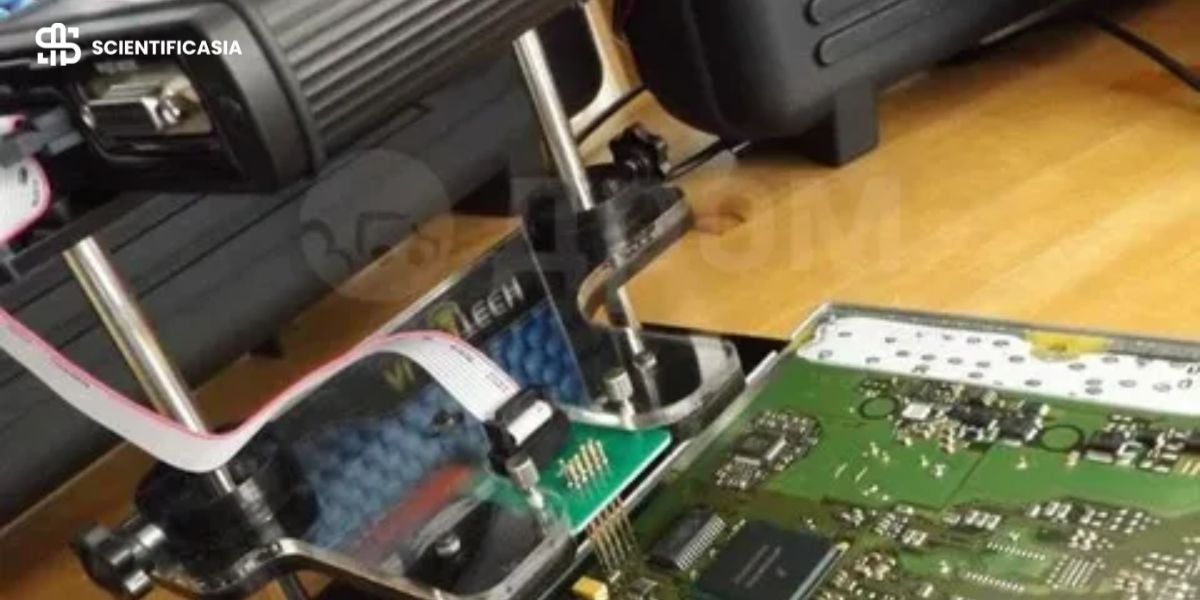
When a replacement engine computer is fitted to a modern car, it rarely works by simply bolting it in. The unit usually has to be programmed and adapted to that specific vehicle before the engine will start and every system will behave normally. Understanding why that is the case means looking at what an engine control unit actually is, how it came to be so tightly integrated with the rest of the car, and what operations are involved in getting a new or used one to work. This is a guide to ECU programming: what it involves, why it matters, and the kinds of tools that make it possible.
What Is an ECU?
ECU stands for Electronic Control Unit, and in the broadest sense it refers to any electronic module, effectively a small dedicated computer, that controls part of a vehicle electronically. By that definition a car contains many ECUs. The unit that deploys the airbags (the SRS module), the one that manages the anti-lock brakes (ABS), the body control module, and even the head unit that runs the audio system are all electronic control units. Modern vehicles can carry dozens of them, networked together so they can share information and coordinate.
Because the term is so broad, it helps to focus on the one most people mean when they talk about ECU programming: the engine control unit, the computer that manages how the engine runs.
A Short History of the Engine Control Unit
The engine control unit as we know it arrived with the decline of the carburetor. A carburetor mixes air and fuel mechanically, aiming for the ratio at which fuel burns most completely, which for gasoline is about 14.7 parts air to one part fuel by weight, known as the stoichiometric ratio. Meeting tightening emissions standards demanded far more precise control over that mixture than a carburetor could deliver, and electronics were the answer.
Electronic fuel injection began in the late 1950s with the Bendix Electrojector, an analog system offered briefly by Chrysler for 1958. It was ahead of its time and unreliable, and Bendix shelved it, but a licensing agreement between Bendix and Bosch carried the idea forward. Bosch refined it into the D-Jetronic system, introduced on Volkswagen models in the late 1960s as a way to meet US emissions rules. Through the 1970s these early units mostly did one job, firing the injectors, often in groups rather than individually. Systems such as Bosch L-Jetronic, used on cars like the Datsun 280Z, added airflow metering and early diagnostic capability, though the control was still crude by modern standards.
From there the pace picked up. Engineers gained precise control over the timing of each injector and each spark event, and introduced the fuel, ignition, and timing maps that let a single engine run well across a wide range of conditions. By the 1980s the engine control unit had taken on a second role beyond running the engine: theft protection. The idea was simple. A transponder chip in the key identifies itself to the engine controller, and only if the controller recognises the key does it allow the engine to start. That link between the key, the immobiliser, and the engine computer is the ancestor of the layered security found in cars today.
Why ECUs Have to Be Programmed to the Car
A modern engine control unit is a complex networked computer. It reads a large array of sensors to manage fuelling, spark, and timing, and to keep the engine running cleanly across changes in temperature, altitude, fuel quality, and driving style. It is also no longer a standalone box. It sits inside the vehicle’s drivetrain and security architecture, communicating with the other modules over the car’s internal networks and authenticating itself before the vehicle will start and operate.
Manufacturers have used that integration to make engine controllers difficult to swap. Every carmaker now has its own method of tying an engine controller to a specific vehicle, protected by encryption and matched across several modules. A few examples show how varied these systems are:
Volkswagen Group uses Component Protection and Component Security (CP and CS). Matching codes must line up across the engine controller, the transmission controller, and often the instrument cluster, body computer, or steering lock, as well as the key.
Mercedes-Benz uses systems such as FBS4, where data has to match across the engine controller and other modules, and that data is deliberately hard to locate.
BMW uses Individual Serial Numbers (ISN) alongside other layers of obfuscation and encryption, so the correct information has to be found before a module can be exchanged.
Toyota and Lexus communicate between immobiliser modules through an ID code box; resetting it allows a faulty module to be exchanged, but the box itself is usually encrypted and physically hidden.
The purpose of all this is to ensure that one vehicle’s set of controllers only works in that vehicle. Manufacturers increasingly ask module makers to add VIN encryption at the factory, so a given VIN is bound to a given set of ECUs. A side effect, intended or not, is that secondhand modules become far harder to reuse, since a used unit carries the identity of the car it came from.
For an independent workshop, this is where programming becomes essential. When a genuine repair calls for replacing an engine controller, or fitting a good used one to keep a repair affordable, the technician has to retrieve the relevant security data and write it correctly to the new module so the car recognises it. Finding the data is only half the task; writing it to the new unit, in the face of these protections, is often the harder half. In practice a single repair can mean that keys, transmission controllers, and clusters all need to be reprogrammed together so that every protected module agrees.
The Main ECU Programming Operations
ECU programming is not a single action but a set of related operations, and a given job may need several of them.
Reflashing rewrites the software or calibration held in the ECU’s flash memory, for example to update it or load the correct calibration for the vehicle.
EEPROM programming reads and writes the smaller memory area that stores adaptation data and identity information, which is often where security and configuration values live.
Adaptation and coding tell the module how it should behave in this particular car, matching options, engine variant, and equipment.
Checksum correction is required whenever the data in an ECU is changed. The maps and settings inside an ECU are ultimately sequences of bytes, and the unit verifies their integrity using checksums. Change the data without recalculating those checksums and the ECU will reject it, so a programming tool has to compute the correct values before writing.
Working around write protection is sometimes necessary because manufacturers add measures, such as tuning protection on some Bosch units, that guard against unauthorised writes. Legitimate programming tools have to satisfy the conditions the ECU expects before it will accept new data.
Adapting a Replacement ECU
Buying a replacement engine controller, new from the manufacturer or used from a stockist or breaker’s yard, is only the start. A used unit may be a different hardware or software revision, may have come from an engine of a different size, or may carry mileage and configuration that does not match the target car. Before it can go into service it has to be prepared: told the correct engine variant, given the right calibration, and matched to the vehicle’s security.
That preparation is what separates a working repair from a car that starts but throws a dashboard full of warning lights, with systems such as power steering or ABS refusing to function because the modules do not agree. Getting a donor ECU to behave exactly as the original did, including telling a controller that came from a 2.3 litre engine to run a 2.0, is the core of this kind of programming, and it is demanding work.
Tuning and Emissions Programming
A separate reason to program an ECU is to change how the engine performs. Modern turbocharged engines respond dramatically to software changes. Where extracting more power once meant physical work such as porting, larger camshafts, and reworked intake and exhaust, a great deal can now be achieved by rewriting the engine’s maps. Popular modern platforms, including BMW’s B58 and S58 engines paired with the widely praised ZF 8HP automatic transmission, can gain very large power increases from bolt-on hardware and a revised tune.
The current generation of Bosch engine control units, the MD1 and MG1 families, sits at the centre of many of these cars. These units are heavily protected, and access to them has become progressively harder with each model year, with additional locks introduced on the most recent versions that the tuning community continues to work on.
Tuning itself comes back to checksums. Because the fuel, ignition, and timing maps are just bytes, they can be read out, modified in tuning software, and written back only if the checksums are recalculated so the ECU accepts the modified data. A capable programming tool handles that checksum work as part of the process.
One point the enthusiasm around tuning often skips over is legality. Modifications that affect a vehicle’s emissions systems, such as removing catalytic or particulate hardware or disabling emissions controls in software, are regulated in most markets and are illegal on road-registered vehicles in many jurisdictions, including under the US Clean Air Act and equivalent European rules. In practice such changes are restricted to off-road, track, or competition use. Anyone modifying an engine should understand the rules that apply where the vehicle is driven before making changes.
Choosing a Tool for ECU Programming
The tools that carry out this work fall broadly into two camps. Manufacturers’ own OEM equipment is built to program their vehicles, but it is expensive, restricted, and generally available only within franchised networks. Independent aftermarket diagnostic and programming tools exist to give workshops outside those networks the ability to carry out the same repairs, including fitting used or replacement modules without OEM equipment.
A strong ECU programming tool needs to do several things well: read and write the full range of information from the widest range of ECUs, handle EEPROM and flash memory, calculate checksums correctly, and satisfy the security and write-protection conditions that modern units impose. Because the protections change constantly, the practical measure of a tool is how well it keeps up, since coverage that was current a year ago may already be behind on the newest vehicles. For an independent technician, the value of the right tool is straightforward: it makes an otherwise impossible or dealer-only repair achievable in the workshop.
Conclusion
ECU programming covers a wide set of operations, from adapting a replacement engine controller to a vehicle’s security system, through reflashing and EEPROM work, to checksum correction and performance tuning. What ties them together is the reality that a modern engine computer is deeply woven into the car around it, and getting a new or modified unit to work means satisfying every layer of that integration. The better the tool and the deeper the understanding behind it, the more of that work an independent workshop can take on, and the more repairs it can offer customers that would otherwise be locked to the dealer.