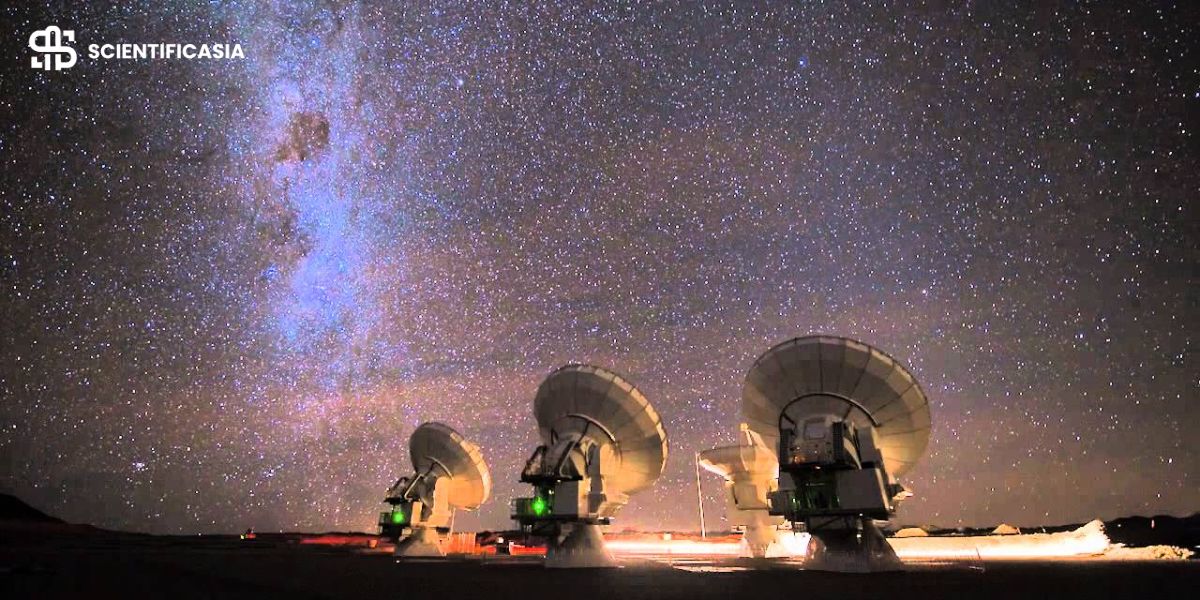
The Atacama Cosmology Telescope (ACT) is a six-meter diameter telescope on Cerro Toco in the Atacama Desert of northern Chile. It is designed to make high-resolution measurements of the cosmic microwave background (CMB) temperature and polarization anisotropies and detect massive galaxy clusters via the thermal Sunyaev Zel’dovich (tSZ) effect. Reconstruction of the CMB lensing potential will play a key role in the cosmological detection of neutrino mass, and measuring the imprint of primordial gravitational waves in B-mode polarization could provide unique insights into the early universe and quantum nature of gravity.
ACT data products are officially distributed through NASA LAMBDA (Legacy Archive for Microwave Background Data Analysis) and associated ACT collaboration repositories.
Official ACT Data Portals
NASA LAMBDA ACT Data Repository
The primary official access point for downloading raw and processed ACT datasets is the NASA LAMBDA ACT Data Product Portal. This central repository hosts long-term project files, maps, and technical metadata.
The portal provides structured download tables for various project tiers.
- ACT temperature and polarization maps
- Power spectra (TT, TE, EE, BB)
- Beam profiles and calibration products
- Mask files and simulations
- Likelihood codes used in cosmological parameter estimation
ACT Advanced Products Tables
For direct programmatic downloads and data analysis pipelines, researchers use specific, dedicated tables structured across the hardware generations.
The indexes are split directly by receiver eras.
- Legacy MBAC hardware files are managed on the ACT Legacy Data Product Table.
- Second-generation polarization arrays are cataloged on the ACTPol Data Product Table.
- Multi-frequency and advanced arrays are indexed on the Advanced ACTPol Data Product Table.
ACT Princeton Official Project Hub
The mission-level home base containing hardware configurations, field logs, and administrative project histories is the ACT Project Hub at Princeton University. This hub acts as the main organizational documentation center.
- Instrument design overviews (ACT, ACTPol, AdvACT)
- Observational strategy and scan catalogs
- Complete bibliography of official collaboration publications available on the ACT Papers Index.
Simons Foundation ACT Final Data Release Announcement
The public summary and high-level structural overview tracking the closeout of the project’s data era is published via the ACT Final Major Data Release on Simons Foundation. This release marks the culmination of the survey’s observational data mapping.
- Consolidated multi-year sky maps
- Systematics correction pipelines
- Public release context and project timelines
ACT Cosmology Paper (ArXiv Primary Dataset Reference)
The exact mathematical and algorithmic baseline defining the processing of the final dataset is detailed in the primary pre-print publication, The Atacama Cosmology Telescope: DR6 Maps on arXiv (2503.14451).
- Map-making pipeline variables
- Gain calibration coefficients
- Ground-level systematic noise models accessible via the direct ACT DR6 Data Directory.
What “ACT Data” Actually Contains
The ACT data ecosystem is divided into specific structural classes designed for scientific analysis pipelines.
CMB Sky Maps
- Temperature anisotropy maps (T)
- Polarization maps (Q,U)
- Multi-frequency co-added maps suitable for custom foreground separation
Power Spectra Products
- TT (Temperature–Temperature) angular data
- TE (Temperature–Polarization) cross-spectra
- EE (Polarization–Polarization) modes
- BB (Gravitational lensing and primordial tensor modes)
Lensing Data Products
- Lensing convergence maps (κ)
- Reconstructed lensing potential fields
- Cross-correlation lensing templates
Instrument & Simulation Data
- Beam transfer functions
- Instrument noise realizations
- Monte Carlo simulation matrices
ACT Instrument Evolution and Data Lineage
The data products archived on LAMBDA reflect three distinct generations of telescope receivers and active data collection phases.
MBAC (First Generation Receiver)
The Millimeter Bolometric Array Camera (MBAC) mapped the CMB temperature anisotropies over an area of around 1000 square degrees from 2008 to 2010 with spectral bands centered at 148, 218 and 270 GHz and an angular resolution of 1.4 arcminutes at 148 GHz. Core data milestones from this era include:
- The first measurement of the power spectrum of the CMB lensing potential Das et al. 2011, providing evidence for dark energy from the CMB alone Sherwin et al. 2011.
- The first statistical detection of the kinematic Sunyaev Zel’dovich effect Hand et al. 2012.
- Measurements of primary and secondary CMB temperature anisotropy power over 600 square degrees Sievers et al. 2013.
- A catalog of tSZ-selected galaxy clusters and associated cosmological constraints Hasselfield et al. 2013.
- Detection of the tSZ effect in 1013 solar mass halos by stacking with FIRST and NVSS catalogs Gralla et al. 2014.
- Discovery of El Gordo, an extreme high-redshift merging galaxy cluster Menanteau et al. 2012.
ACTPol (Second Generation Receiver)
The second-generation, polarization-sensitive receiver ACTPol observed between 2013 and 2016. The four-year survey consists of 17,000 square degrees of the sky mapped at 98 and 150 GHz, with the deepest 600 square degrees at a noise < 10 μK-arcmin. This camera implemented multi-chroic polarization sensitive detectors operating at 100 mK. Core data releases include:
DR3
- Measurement of the TE and EE power spectra Naess et al. 2014.
- Reconstruction of the CMB lensing potential using temperature and polarization data in cross-correlation with the cosmic infrared background van Engelen et al. 2015.
- First Measurement of Lensing of the CMB by Dark Matter Halos Madhavacheril et al. 2015.
DR4
- DR4 Maps and Cosmological Parameters Aiola et al. 2020.
- DR4 Power Spectra at 98 and 150 GHz Choi et al. 2020.
- CMB lensing mass map over 2100 square degrees of sky and its cross-correlation with BOSS-CMASS galaxies Darwish et al. 2020.
- Constraints on Cosmic Birefringence Namikawa et al. 2020.
- Component-separated maps of the CMB temperature and the thermal Sunyaev-Zel’dovich effect Madhavacheril et al. 2020.
- DR4 Delensed Power Spectra at 98 and 150 GHz and Cosmological Parameters Han et al. 2021.
DR5
- Optimally coadded ACT and Planck maps to create high-resolution large area maps of the microwave sky Naess et al. 2020.
Advanced ACTPol (AdvACT, Third Generation)
The third generation Advanced ACTPol receiver extended the frequency coverage down to 20 GHz and has been surveying 40% of the sky since 2016. It implemented expanded multi-chroic detector arrays operating at 100 mK to optimize wide-area polarization sensitivity.
ACTViewer
ACTViewer is a tool developed by the ACT team that provides a visualization of the ACT DR5 (and ACT+Planck) skymaps. Different combinations of data can be interactively viewed. A copy of the interactive tool is hosted directly on the NASA LAMBDA ACTViewer Interface.
- Interactive sky map visualization
- Multi-frequency layer toggling
- Comparison of ACT-only vs ACT+Planck data models
- Visual tracking of spatial map systematics
Cosmological Role of ACT Data (Scientific Use Cases)
ACT datasets provide the direct observational variables needed to constrain several key cosmological parameters.
- Neutrino Mass Constraints: Derived from the small-scale amplitude suppression of the CMB lensing potential map.
- Dark Energy Geometry: Established via joint constraints pairing ACT lensing files with external Baryon Acoustic Oscillation surveys.
- Inflationary Physics: Restricted through tight upper-bound constraints on B-mode polarization arrays.
- Large Scale Structure: Calculated by analyzing the tSZ galaxy cluster catalogs alongside cross-correlated lensing mass maps.
How to Access and Download ACT Data
Step 1 — Select Dataset Class
Navigate to the central NASA LAMBDA ACT Directory to determine your data path requirements (maps, spectra, lensing products, or simulations).
Step 2 — Locate Target Files
Access the specific generation index table, such as the Advanced ACTPol Data Product Table, to filter the data files by operational frequency or processing cut.
Step 3 — Download Product Files
Execute file downloads for your target arrays. Spatial files are delivered in standard .fits formats, while cosmological fitting pipelines require downloading the dedicated likelihood software blocks.
Step 4 — Verify File Structure
Cross-check your local file headers and calibration variables using the official operational documentation hosted on the ACT Princeton Hub.
Key Citation Anchors
- MBAC Lensing Power Spectrum: Das et al. 2011
- Dark Energy Evidence: Sherwin et al. 2011
- Kinematic SZ Detection: Hand et al. 2012
- tSZ Galaxy Cluster Catalog: Hasselfield et al. 2013
- ACTPol DR3 Polarization: Naess et al. 2014
- CMB Lensing Reconstruction: van Engelen et al. 2015
- Halo Lensing Discovery: Madhavacheril et al. 2015
- DR4 Cosmological Parameters: Aiola et al. 2020
- DR4 Power Spectra: Choi et al. 2020
- Joint ACT-Planck Maps: Naess et al. 2020
- Final Cosmic Data Release (DR6): ACT Collaboration 2025, arXiv:2503.14451