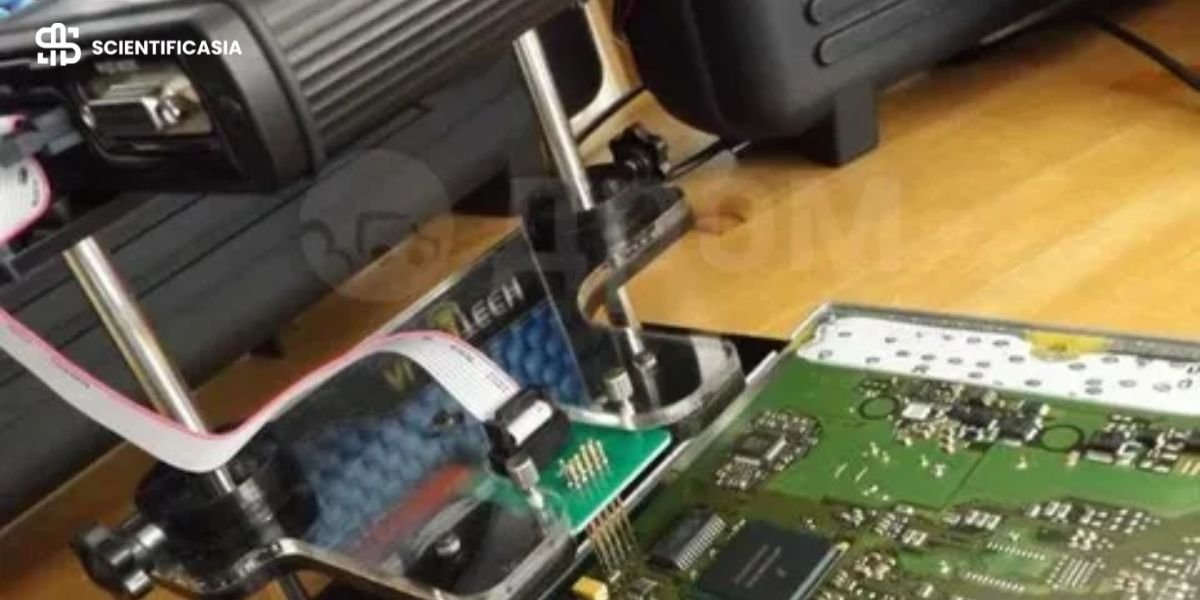
Often, the blog posts here are too specific; we jump into a topic without considering that context needs to be provided. We need to look at the aspects of topics where we provide a bit more detail. We need to look at the reasons why an ECU needs to be programmed to a vehicle, what operations are needed for ECU programming, what tools we can use for ECU programming, what the best tools are, and last but not least, what an ECU is at the end of the day.
I. What is an ECU?
ECU is an abbreviation, and ECUs are what we most often refer to in two things in the sense of the automotive industry. In the broad sense, we can say that the abbreviation means “Electronic Control Unit,” which is a general term for any electronic unit or a computer, if you wish, that controls a certain part of the vehicle electronically. This is very broad, meaning that it can refer to any one of the modules in the car – it can be an SRS- AIRBAG, Body, or ABS ECU, it can also refer to the module which controls the speakers in the car – the radio, if you wish. So, I think this is too broad a term, even though I firmly believe we are the best tool for programming any module in most cars.
The Birth of the First ECU – The Engine Control Unit
I think today we must focus on two very important topics, and focus on the first ever ECU- the “Engine Control Unit”. Hence, we need to be boring and start from the beginning. The ECU, as a term, started with the demise of the carburetor as a tool for mixing air and fuel and aiming for that 14:1 parts air to fuel to make an engine run. We credit companies such as Bendix and Bosch for their inception in the late 1950s; ever since then, the ECUs have been developing at a rapid pace. All they did up to the 1970s was to fire the injectors, then the distributor cap was rendered obsolete because of the missing tooth telling them when cylinder one was at top dead center – TDC.
Evolution of ECU Technology and Advanced Control Systems
Hi Edwin and Will! The L-Jetronic by Bosch and Kent Moore added the first real diagnostic tool ever to diagnose the engine’s behavior, but it was quite rudimentary as it fired all six injectors of the Datsun 280Z at every four-stroke cycle. You can watch Roland Finger’s video on that. As technology and time progressed, we started having precise control over the firing of each injector, each spark plug. We saw the introduction of different modes and fuel, ignition, and timing maps; we had precise control, and in the 1980s we started seeing that the Engine Control Unit was now also used as theft protection. The concept was simple – a transponder chip in the key told the engine controller that this is the key to start it, and it allowed the engine to run. Interesting indeed. You can read more in our EFI (Electronic Fuel Injection) blog.
II. Programming ECUs to operate in the car.
Back in modern times. ECUs are now complex computers; they use multiple sensors to control the fueling, spark, and advancement, and help the engine handle various outside and inside conditions – temperature, altitude, quality of fuels, style of driving- they know more about your driving preferences and the condition of your car than you know yourself.
Leading ECU Manufacturers and Their Engineering Approach
Manufacturers know that companies such as Bosch, Continental, Denso, Motorola, and Siemens VDO have created the most sophisticated controllers, and they want to use all of their potential. This is part of an engineer’s DNA. So, they started incorporating even more complicated methods for replacing ECUs and incorporating them into the immobilizing system of modern vehicles.
Challenges of ECU Durability and Environmental Exposure
The fact that ECUs are complex electronic devices installed in machines that move around at quite a pace, often exposed to the elements, heat, vibration, and just getting old, was always going to be a challenge. But manufacturers love to add a bit of accounting and marketing. That is where they saw an opportunity to expand.
Manufacturer-Specific Adaptation and Authentication Systems
Nowadays, every manufacturer has their own method of adaptation of engine controllers, and these engine controllers are part of the drivetrain control system of modern vehicles. They use authentication to communicate over different protocols to the rest of the modules of the vehicles to permit start and operation.
Examples of Advanced Security: Volkswagen, Mercedes, BMW
We typically see a specific code, protected under many layers of encryption. For example, Volkswagen AG and its subsidiaries use what is known as CS and CP (Component Security and Component Protection). These codes need to match in the engine controller, transmission controller, sometimes cluster, sometimes body computer, sometimes steering lock, and of course, the key to operate.
In Mercedes, it is even more complex because the data from the Engine Controllers needs to match in the same other modules, but it is much more difficult to find. Look at the articles on FBS4. In BMW, we have ISN numbers (Individual Serial Numbers), we also have other forms of protection, obfuscation, and encryption, and we need to once again find all the information.
The Difficulty of Data Retrieval and Module Programming
Finding the information is only half the battle- the other half is the battle of writing said information to the new module. We find it more and more difficult to find ways of doing that.
Toyota/Lexus Methods, VIN Encryption, and the Role of Independent Tools
Some companies have a seemingly easier method – in Toyota and Lexus, for example, the communication between the immobilizer modules is done via the ID CODE box – if you reset it, you can exchange a faulty module. The ID code box, however, is not willing to play ball; it hides in strange places and is usually encrypted. Every manufacturer has their own ways of providing protection and, of course, they want to be the only ones who can achieve it. This is often covered in more than one layer, like an onion; you have to peel it and cry at every step. Oftentimes they request from the companies that produce the modules to add VIN encryption from the factory – one VIN, one set of ECUs, and that will also mean that you cannot use secondhand modules.
This is where we come in – it is our duty to provide you, the independent diagnostician, with the opportunity to perform SEAMLESS integration of a used part into your customer’s vehicle without the requirement of OEM tools. This is a hard task because, as the examples above suggest, we need to overcome outstanding technical challenges. But in my mind, the company that produces the best tool for ECU programming is the company that thinks like its customers, attends to your needs, and understands the position you are in. We expect a reciprocal from you too. This often means that keys and transmissions and clusters need to be reprogrammed, too.
III. Programming ECUs to change their characteristics.
Now, to program an ECU in a car, we need to either buy it from the manufacturer or buy it used. Websites online and online stores keep huge stock, also the scrap yards do. But the ECU you buy may not be a perfect match- it may be a newer or later hardware or software revision, it may be a higher mileage one, it may be a lower mileage one- it may also be any of the above combined. You have to have the ability to prepare it for adaptation in the vehicle. This brings us back to that phrase – seamless integration. You cannot tell the customer, “Listen, your new/ used ECU is programmed but there is a Christmas tree of lights on the dash, and, by the way, your power steering and ABS don’t work, but pay me 2000 EURO for the job”.
We want to be able to reprogram the ECU- if we need to reflash it, if we need to program its EEPROM, if we need to tell it to command a 2.0 engine but it came out of a 2.3 engine. We try to be on top of all that. So, we have tools such as the Abrites Engine Control Unit Programming Tool, which can read and write any and all information from most ECUs. As I mentioned above, writing is an even harder battle sometimes. We need to calculate checksums, we need to figure out ways around tuning protection (TPROT), and we need to make sure all conditions the ECU requires are met. It is an uphill battle all the time and it never ends for us.
IV. Tuning and Emissions ECU Programming.
Another very important factor. People are tinkerers, and in our technologically advanced time, it is now, more than ever, easier to tinker and know a lot about volumetric efficiency. The following example applies to most current turbocharged cars, but I will use the B58/S58 as an example. We used to have to port match gaskets, put higher lift and longer duration cams, optimize fuel, intake, exhaust, but nowadays anyone can buy a …40i or an M3/ M4, slap a downpipe and a tune on it, and get 700hp.
Paired with the king of transmissions – the ZF 8HP to be the icing on the cake. This brings me to another important topic, and that is the ECUs installed in these cars – the now infamous Bosch MD1 and MG1- the latest generation of peak ECU technology we know. At the moment, we can exchange those up to 2021 and they have an additional lock after that, which we are still battling. I want to say that 2026 will be the year we achieve success in managing those.
Checksum calculation is something very important because all the fuel, ignition and advancement maps are nothing more than series of bytes -using our tools we can read them, you can modify them in tuning software of your choice but since they are bytes, we cannot just slap them back to the ECU and hope for the best. The best ECU programming tool should be able to reprogram the checksum of the ECU to allow its normal (or new normal) operation. We do that for you in all of the supported ECUs, and we are expanding.
V. Conclusion.
There are many operations we must go through to perform proper ECU programming, but we are aware that the best ECU programming tools need to be able to perform seamless integration of ECUs and tuning to satisfy the needs of you guys so that you can in terms, satisfy the needs of your customers. If I had to say what the best tool for ECU programming is I have to say it is… Come on, you are reading the Abrites blog.
Until next week, try to have fun at work!